Beyond the Hype: What Quantum Computing Actually Means for the Rest of Us
If you have spent any time reading tech news over the last couple of years, you have probably run into sensational headlines declaring that quantum computers are about to change everything overnight. Some articles promise they will crack all digital encryption by next Tuesday; others claim they will solve global climate change before lunch.
When you strip away the corporate PR and hype-driven journalism, the reality of quantum computing is far more nuanced—and honestly, much more interesting than the sci-fi tropes suggest.
Ditching the Maze: How Qubits Really Work
To understand why everyone is obsessing over this tech, it helps to start with the laptop or smartphone you are using right now.
Classical computers, no matter how powerful, are essentially incredibly fast counting machines. They rely on silicon transistors that act as tiny light switches: turned off (0) or turned on (1). Every email you type, video you stream, or game you play gets translated down into billions of these binary ones and zeros.
Quantum computers throw that binary model out the window. Instead of traditional bits, they use qubits (quantum bits). Thanks to a mind-bending physics property called superposition, a qubit doesn’t have to choose between being a 0 or a 1; it can exist in a state that represents combinations of both at the same time.
Think of it like a coin. A classical bit is like a coin resting flat on a table—it is clearly either heads or tails. A qubit in superposition is like that same coin spinning rapidly on its edge. While it spins, it carries the possibilities of both heads and tails simultaneously until you slap your hand down on it to take a reading.
When you link multiple qubits together through another phenomenon called entanglement, the system’s processing potential scales exponentially.
Imagine trying to find your way through a massive maze:
- A classical computer acts like a single person running down one path, hitting a dead end, backing up, and trying the next path one by one. Even if it runs really fast, it has to check paths sequentially.
- A quantum computer acts like a flood of water poured into the entrance. It explores every single pathway, dead end, and turn simultaneously, finding the correct exit route in a single sweep.
The Hardware Nightmare: Cold, Fragile, and Moody
If quantum computers are so capable, why isn’t there one sitting under your desk next to your graphics card?
Because keeping qubits stable is one of the hardest engineering challenges humanity has ever attempted. Qubits are absurdly delicate. The slightest environmental disruption—a tiny fluctuation in temperature, stray electromagnetic radiation from a cell tower, or even a subtle vibration from someone walking down the hall—can cause them to lose their quantum state. In the industry, this failure is called decoherence.
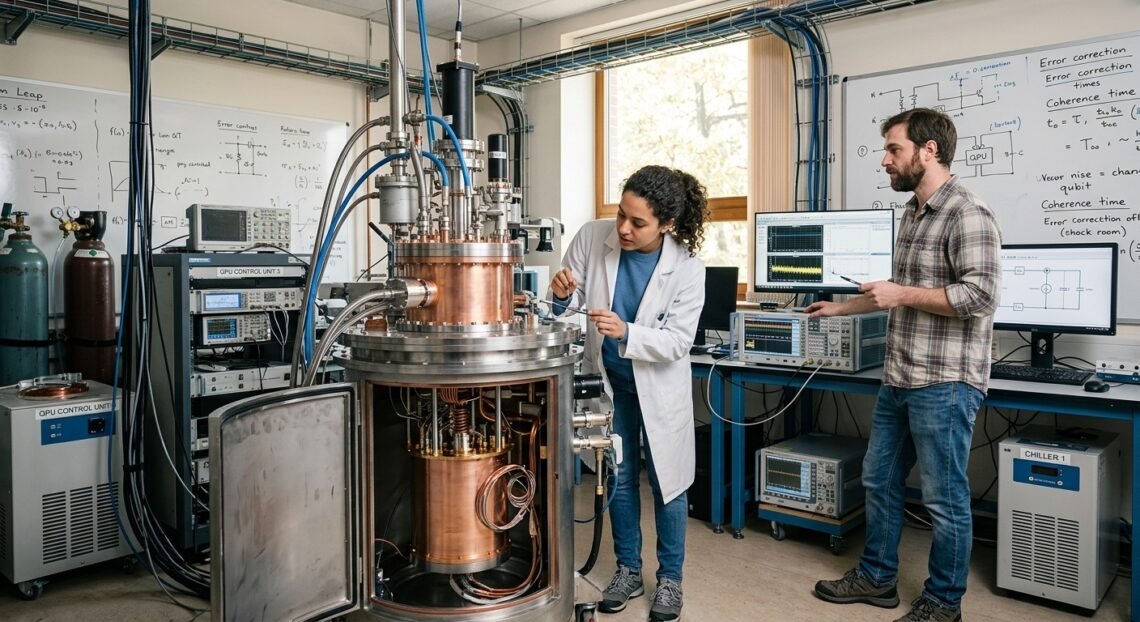
To prevent qubits from collapsing into plain old ones and zeros, most quantum systems (like those built by IBM, Google, or Rigetti) have to be suspended inside massive, brass chandeliers called dilution refrigerators. These machines chill the quantum processor down to around -273°C (-459°F)—temperatures colder than deep space.
It takes an entire room full of pumps, liquid helium lines, and specialized microwave cabling just to keep a chip the size of a postage stamp cool enough to run calculations for a fraction of a second.
What Will Quantum Computers Actually Do?
Despite what clickbait headlines suggest, you won’t be using a quantum computer to load web pages faster or get higher framerates in video games. For basic daily tasks, classical silicon processors will always be cheaper, faster, and far more practical.
Where quantum machines will actually make a difference is in handling massive, highly complex math problems that would cause a traditional supercomputer to choke:
- Molecular Simulation and Drug Discovery: Simulating how complex molecules fold and interact in real life requires calculating countless atomic interactions. Classical computers have to make rough approximations. Quantum systems can simulate physics at the atomic level, potentially reducing the time it takes to develop life-saving drugs or discover new battery chemistries from decades to months.
- Logistics and Supply Chains: Finding the optimal route for thousands of delivery trucks across global trade networks involves trillions of changing variables (traffic, weather, fuel costs). Quantum algorithms excel at finding global maximums in massive datasets.
- Materials Science: From designing room-temperature superconductors to creating more efficient catalysts for fertilizer production, modeling quantum interactions directly on quantum hardware opens up entirely new classes of materials.
The Road Ahead
We are currently living in what physicists call the NISQ era—Noisy Intermediate-Scale Quantum. The machines we have built so far have anywhere from dozens to a few thousand qubits, but they are still plagued by high error rates.
The immediate goal for researchers isn’t just adding more qubits; it’s building fault-tolerant quantum systems using quantum error correction. That means grouping hundreds of physical, noisy qubits together to create a single “logical qubit” that can run long, reliable calculations without breaking down.
We aren’t going to wake up next year to a world completely run by quantum systems. It will be a gradual roll-out, with cloud-based quantum processors working alongside traditional supercomputers behind the scenes. But make no mistake: the transition from classical bits to quantum states is one of the most fundamental shifts in computation since the invention of the transistor.