Hacking the Thermostat: The Risky, Necessary Reality of Climate Engineering
For decades, the global strategy on climate change was simple, at least on paper: cut emissions, transition to renewables, and adapt to the shifts already set in motion. But as extreme weather continues to shatter historical records and global emissions remain stubbornly high, a once-fringe idea is forcing its way to the center of the debate.
What if cutting emissions isn’t enough anymore? What if we have to physically intervene in the Earth’s atmosphere to pull carbon out of the sky or manually block incoming sunlight?
Welcome to the complicated, high-stakes world of climate engineering and carbon capture. We are no longer just discussing how to stop damaging the planet; we are actively debating how to engineer our way back out.
Cleaning the Sky: Carbon Capture and Removal
Before touching the solar dial, the primary focus remains on taking back the carbon we’ve already dumped into the atmosphere. “Carbon capture” actually spans two distinct strategies: capturing emissions at the source (like a factory smokestack) and pulling existing carbon straight out of ambient air (Direct Air Capture, or DAC).
While traditional industrial capture stops new pollution from escaping, DAC acts like a giant vacuum cleaner for historical emissions.
                 [ INDUSTRIAL EMISSIONS & DAC ]
                               |
                               v
                       (Chemical Binding)
                               |
            +------------------+------------------+
            |                                     |
            v                                     v
   [ DEEP SEQUESTRATION ]               [ CIRCULAR UTILIZATION ]
   Pumped thousands of feet             Turned into synthetic fuels,
   underground into basalt              concrete, or industrial
   rock to mineralize permanently.      feedstocks.
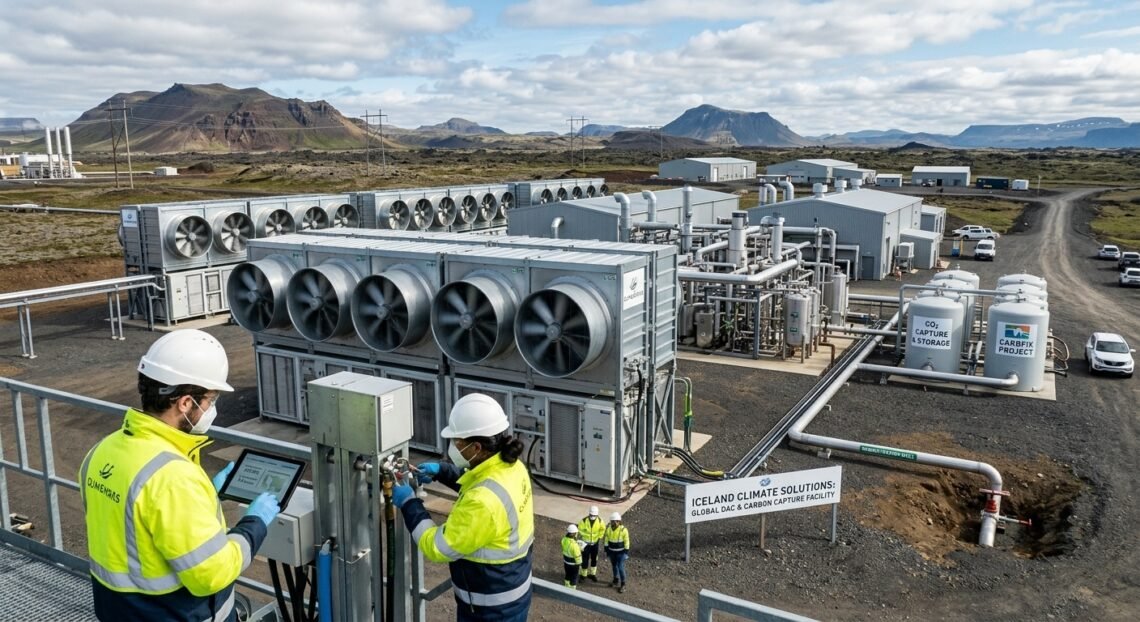
Technologically, DAC works. Companies are operating facilities in places like Iceland and Texas that trap atmospheric $\text{CO}_2$ using chemical sorbents, heat it to release pure gas, and inject it deep underground where it turns to stone. The catch? Scale and cost.
Right now, pulling a single ton of $\text{CO}_2$ out of the air costs hundreds of dollars. To make a real dent in climate change, we need to remove billions of tons every year.
The Big Interventions: Solar Radiation Modification
If carbon removal is about cleaning up the past, Solar Radiation Modification (SRM) is about buying time for the future. SRM doesn’t remove greenhouse gases; instead, it attempts to cool the Earth by reflecting a small percentage of the sun’s rays back into space.
It is the most controversial domain in environmental science today.
| Geoengineering Concept | How It Works | Key Promise | Major Risk |
| Stratospheric Aerosol Injection (SAI) | Releasing reflective sulfur particles into the upper atmosphere to mimic volcanic cooling. | Rapid global temperature reduction at relatively low cost. | Could alter global monsoon patterns and disrupt agriculture. |
| Marine Cloud Brightening (MCB) | Spraying sea-salt aerosols into low ocean clouds to make them whiter and more reflective. | Localized cooling to protect sensitive ecosystems like coral reefs. | High regional uncertainty; impacts weather downwind. |
| Direct Air Capture (DAC) | Using giant fan arrays and chemical filters to scrub $\text{CO}_2$ directly from ambient air. | Addresses the root cause by lowering atmospheric carbon levels. | Extremely energy-intensive and currently very expensive. |
The Dilemma of “Termination Shock”
The biggest concern scientists have regarding solar geoengineering isn’t just the unpredictable weather shifts—it’s the geopolitical dependency.
If a coalition of nations begins spraying sulfur into the stratosphere, it acts like a temporary blanket. If a war, technical failure, or political rupture causes that spraying to abruptly stop while underlying carbon emissions have continued to rise, the planet would experience termination shock. Temperatures would jump rapidly in a matter of years, overwhelming natural ecosystems and human infrastructure.
The Moral Hazard: A License to Pollute?
There is also a profound psychological conflict at play. Critics argue that investing heavily in climate engineering creates a “moral hazard.” If fossil fuel companies and governments believe a technological silver bullet can cool the planet or scrub their pollution, the urgency to phase out fossil fuels vanishes.
Proponents counter that we have simply run out of comfortable options. In their view, climate engineering isn’t a replacement for decarbonization—it’s an emergency brake to prevent runaway tipping points (like the melting of Arctic permafrost) while grid transition work continues.
Where We Go From Here
We are stepping out of the era of passive observation and into an era of active planetary management. Carbon capture is already scaling, backed by billions in public and private capital. Solar geoengineering remains strictly in computer models and minor localized tests, but the political pressure to study it is growing every year.
The challenge of this century won’t just be inventing these technologies; it will be agreeing on who gets to hold the remote control to the planet’s thermostat.