Beyond the Keyboard: How Brain-Computer Interfaces Are Silently Rewiring Our Future
A few decades ago, controlling a computer with your mind sounded like a plot point stolen straight from a cheesy sci-fi novel. You would picture futuristic cyborgs, shiny metallic headpieces, or dystopian thrillers. But if you look closely at what is happening in neurotech labs right now, the boundary between sci-fi and reality isn’t just blurring—it’s pretty much gone.
Brain-Computer Interfaces, or BCIs, have quietly moved out of pure theory and into clinical human trials. We aren’t talking about pop-culture telepathy or hive minds just yet. At its core, BCI technology is about giving the human brain a direct output channel to digital devices, skipping our biological peripheral nerves and muscles entirely.
How it Actually Works (Without the Buzzwords)
Every single thought, movement, or intention in your head is driven by billions of neurons firing tiny electrical impulses. When you decide to move your right hand, a tiny cascade of voltage changes sweeps through your motor cortex.
Normally, those signals travel down your spinal cord, fire off peripheral nerves, and flex your muscles. If that pathway is severed—say, due to a spinal cord injury, a stroke, or ALS—the brain keeps firing those commands, but the message gets lost in transit. The body simply can’t execute the command because the physical wire is broken.
BCI hardware acts like an emergency detour. It intercepts those raw electrical signals directly from the brain, filters out the background electrical noise, and feeds the clean data to machine-learning algorithms. The system decodes the electrical pattern—identifying, for instance, “this specific signal means move the cursor up”—and translates it into immediate action on an external screen or mechanical device.
Three Routes into the Brain
Not all BCIs are built the same, and researchers are split on which approach will scale best in the long run.
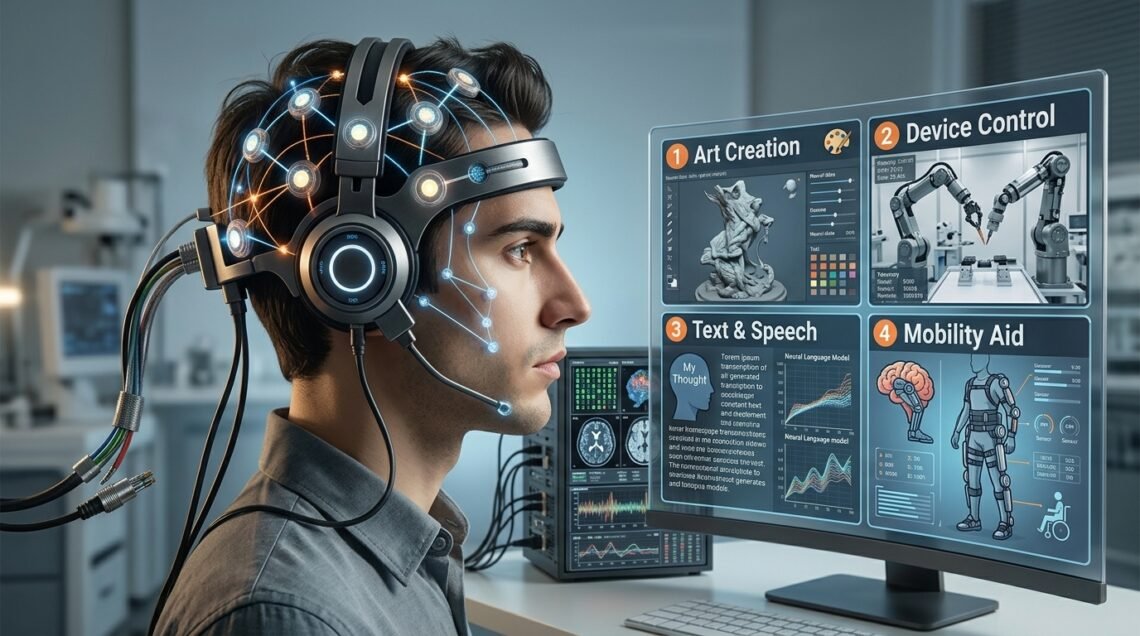
- Non-Invasive Systems: These are essentially fancy skullcaps packed with electroencephalogram (EEG) sensors. You slap them on, apply some conductive gel, and read brainwaves through the scalp. They are completely safe, cheap, and easy to take off. The catch? The human skull is a terrible electrical conductor. Reading micro-volt neural activity through bone and skin is like trying to listen to a whisper through a thick brick wall. You get a general sense of mental state—like focus or fatigue—but lack pinpoint precision.
- Minimally Invasive Systems: Companies like Synchron take a middle route. Instead of cutting open the skull, they thread tiny stent-like electrode arrays through a blood vessel—usually starting at the jugular vein—and park the sensor in a vessel resting directly next to the motor cortex.It provides a much clearer signal than an EEG cap without requiring full open-brain surgery.
- Invasive Systems:This is where groups like Neuralink, Paradromics, and Blackrock Neurotech operate. These involve placing ultra-thin microelectrode arrays directly into the brain tissue itself. Because the sensors rest right next to active individual neurons, the signal quality is extraordinarily sharp. This high resolution allows paralyzed patients to type text, control wheelchairs, or play video games at impressive speeds. However, surgical risks, tissue scarring, and long-term device stability remain real engineering challenges.
From Restorative Medicine to Daily Tech
Right now, the primary push for BCIs is purely medical—and for good reason. Restoring independence to someone who has lost speech or mobility is profoundly life-changing. We are already seeing clinical trial participants with quadriplegia sending texts, browsing the web, operating powered wheelchairs, and communicating at near-natural typing speeds using only their thoughts.
But what happens when this tech matures enough for the everyday consumer?
That is where things get interesting—and a little eerie. Tech designers envision a future where we bypass keyboards, mice, and touchscreens altogether. Instead of pulling out a phone or sitting down at a desktop to draft an email, you might simply formulate the sentence in your head and let a background BCI stream the text straight to your display. Gamers could execute complex actions with zero physical latency, eliminating the need for a physical controller entirely.
The Privacy Dilemma Nobody is Ready For
It is easy to get caught up in the cool factor, but BCIs bring a wave of ethical questions that make standard internet privacy concerns look tiny.
If a device is constantly monitoring your neural firing patterns, it isn’t just tracking what you click or buy—it is capturing your unfiltered cognitive state. Who actually owns your neural data? What happens if an algorithm can detect early signs of stress, implicit bias, or neurological conditions before you are even consciously aware of them?
Legal experts have already started talking about “cognitive liberty”—the fundamental right to mental privacy and self-determination. In a world with brain-linked hardware, a software exploit or data breach isn’t just a minor annoyance; it’s an intrusion into your private thoughts.
Where We Stand Today
We aren’t going to wake up tomorrow with microchips automatically installed in our heads, nor are mechanical keyboards going extinct anytime soon. Invasive implants are still locked inside strict, long-term clinical trials, while non-invasive caps remain too clunky for casual public use.
Yet, the trajectory is unmistakable. The line between biological cognition and digital processing is thinning out year by year. BCIs aren’t just a fancy accessory for our computers—they represent a fundamental shift in how human beings will interact with technology for the rest of history.