Catching a Star in a Jar: Why the Dream of Fusion Power Is Finally Coming True
For almost three-quarters of a century, fusion energy has been the ultimate scientific running joke: “It’s the clean energy of the future—and it always will be.”
The joke was fair. For decades, the physics required to replicate the core of the sun on Earth seemed frustratingly out of reach. We were asking engineers to contain a chaotic plasma superheated to 100 million degrees Celsius using nothing but invisible magnetic force fields.
Over the past few years, that punchline has quietly expired. We have officially crossed the threshold from asking if fusion is physically possible to figuring out how fast we can wire it into our power grid.
The Moment the Physics Changed
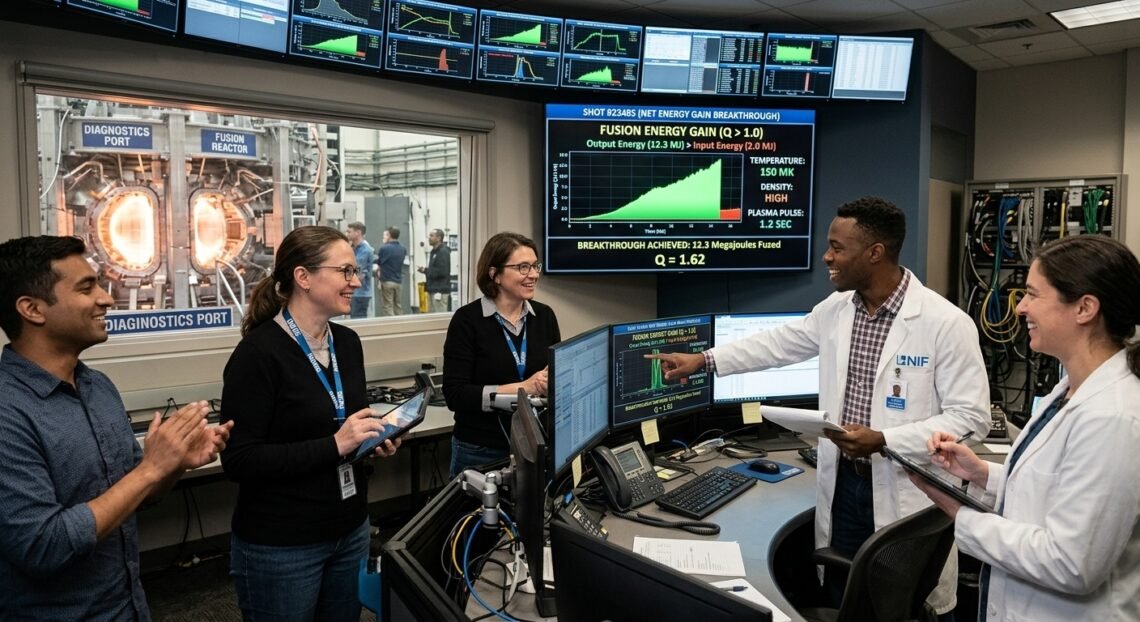
To understand why everyone in energy is suddenly breathless with excitement, you have to look back at what happened at the National Ignition Facility (NIF) in California. For years, fusion experiments consumed far more energy than they produced—a net loss.
Then came the breakthrough: researchers focused 192 massive lasers onto a target the size of a pencil eraser, blasting it into a state of “ignition.” For a fraction of a second, the reaction produced more energy than the laser light injected into the target. It was proof of concept. The physics worked.
       TRADITIONAL FISSION                 NEXT-GEN FUSION
      (Splitting Heavy Atoms)           (Fusing Light Atoms)

   [Uranium] ---> (Split)             [Deuterium] \
                    |                             (Fuse) ---> [Clean Energy]
   [Long-lived Nuclear Waste]          [Tritium]   /            + [Safe Helium]
The Reality Check: Ignition vs. the Power Grid
While lab ignition was a historic achievement, firing a mega-laser once or twice a day isn’t a power plant. To light up a modern city, a commercial reactor needs to run continuously, generating massive net energy every second of every day.
That requires moving away from massive single-shot lasers toward magnetic confinement systems—primarily “tokamaks” (doughnut-shaped magnetic chambers) and “stellarators” (twisted, intricate magnetic loops). And that is where the most recent engineering leaps are taking place.
| Fusion Approach | Primary Mechanism | Current Breakthrough | Main Obstacle |
| Laser Inertial (NIF) | High-power laser compression | Proven net energy gain (ignition) | Scaling repetition rate for grid use |
| Magnetic Tokamak | High-temp superconducting magnets | Compact designs & 20-Tesla magnets | Managing intense heat loads on reactor walls |
| Pulsed Field-Reversed | Direct energy capture (no steam) | High-temperature plasma stability | Reaching self-sustaining fusion loops |
High-Temperature Superconductors: The Game-Changer
The single biggest hardware breakthrough hasn’t been in the plasma itself, but in the magnets used to hold it.
Older fusion devices required giant, room-sized electromagnets that consumed absurd amounts of power. The commercial sector has switched to High-Temperature Superconducting (HTS) tape. These new magnets create immensely powerful magnetic fields in a footprint a fraction of the size.
Because magnetic confinement strength scales exponentially with magnet strength, HTS magnets allow us to build compact, cheaper reactors that can be built in years rather than decades.
AI as the Plasma Whisperer
Even with incredible magnets, keeping a 100-million-degree plasma blob stable inside a metal chamber is like trying to hold a squirming jelly doughnut using only rubber bands. The moment the plasma twists or wobbles, it touches the reactor wall, cools down instantly, and shuts the reaction off. Human operators simply cannot react fast enough to correct these micro-instabilities.
Enter deep learning.
Researchers at the Princeton Plasma Physics Lab and other major institutes are now running artificial intelligence models directly inside the reactor’s control loops. Running on millisecond update cycles, these neural networks analyze live sensor feeds, predict plasma disruptions before they erupt, and dynamically adjust magnetic coils to smooth out the turbulence in real time. AI isn’t just helping us design reactors; it’s actively keeping the star alive inside them.
The Capital Rush
Perhaps the most human indicator that fusion is real is where the money is going.
This isn’t just an academic pursuit funded by slow-moving government grants anymore. Private fusion companies have now raised over $10 billion from venture capitalists, tech founders, and sovereign wealth funds.Tech giants looking at the massive energy demands of future computing infrastructure are actively signing early power purchase agreements with fusion startups.
What The Next Decade Looks Like
We are rapidly approaching the pilot-plant era. The goal for the late 2020s isn’t just demonstrating high-temperature plasma; it’s demonstrating steady-state electricity production fed directly into municipal grids.
Fusion will not solve all our immediate climate challenges overnight. Early power plants will be expensive, custom-engineered facilities that take time to build at scale. But as an ultimate destination for human civilization—an energy source with zero carbon emissions, no long-lived radioactive waste, and a fuel supply derived essentially from seawater—the star in the jar is no longer a sci-fi dream. It’s an engineering problem with an expiration date.
To get a clearer sense of the recent milestones and how scientists achieved net energy gain, check out Nuclear Fusion Breakthrough: How Close Are We Really?
which breaks down the jump from lab results to grid power.