The Invisible Frontier: How Working at the Atomic Scale Is Reshaping Our World
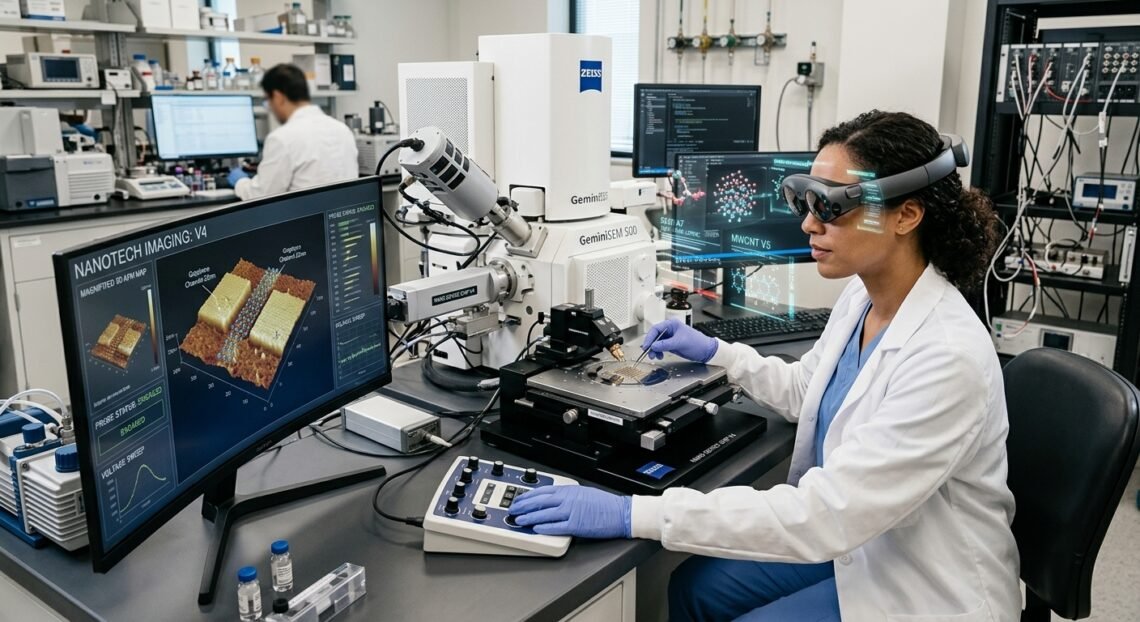
When most people picture technological revolutions, they think big. They imagine towering rocket boosters, sprawling solar farms, or massive server banks humming away in desert warehouses. But one of the most powerful transformations in modern science is happening in the exact opposite direction—down at a scale so impossibly small that the human brain can barely contextualize it.
Welcome to the world of nanotechnology. It is the science of engineering matter atom by atom, molecule by molecule. At this sub-microscopic level, the familiar rules of physics begin to bend, and materials start behaving in ways that feel almost like magic.
Just How Small Is “Nano”?
To understand why working at this scale is such a big deal, you first have to grasp the scale itself. A single nanometer is one-billionth of a meter.
To put that into everyday perspective:
- A single strand of human hair is roughly 80,000 to 100,000 nanometers wide.
- A sheet of printer paper is about 100,000 nanometers thick.
- Your fingernails grow by roughly one nanometer every single second.
When you manipulate materials at this scale—between 1 and 100 nanometers—the ratio of surface area to volume skyrockets, and quantum mechanical effects take over. Gold, which we normally think of as an inert yellow metal, turns red or purple and becomes a powerful chemical catalyst. Carbon, normally soft like graphite in a pencil, can be rolled into nanotubes that are stronger than steel yet lighter than aluminum.
                    [ MACRO-SCALE WORLD ]
            Governed by Classical Physics & Bulk Properties
                               |
                               v
                  [ THE NANOSCALE (1-100 nm) ]
      High Surface Area + Quantum Mechanics Take Control
                               |
            +------------------+------------------+
            |                                     |
            v                                     v
   [ NOVEL MECHANICS ]                   [ OPTICAL & ELECTRICAL ]
   Carbon Nanotubes:                     Quantum Dots:
   100x stronger than steel.             Custom light & energy emission.
Where Nanotechnology Touches Your Life Today
It is easy to assume nanotechnology is still stuck inside university research labs, but the reality is that you likely interact with nanomaterials every single day without realizing it.
| Industry | Application | What the Nanotechnology Does |
| Consumer Electronics | Quantum Dot Displays (QLED) | Tiny semiconductor nanocrystals emit ultra-precise colors on TV screens. |
| Medicine & Health | Targeted Drug Capsules | Lipid nanoparticles wrap around mRNA to deliver vaccines directly into human cells. |
| Energy & Utilities | Advanced Solar Cells | Nanostructured coatings trap more sunlight and reduce energy reflection. |
| Consumer Goods | Fabrics & Sunscreens | Zinc oxide nanoparticles block UV rays without leaving a chalky white residue. |
The Powerhouse Materials: Graphene and Carbon Nanotubes
If there are poster children for the nanotech revolution, they are carbon-based nanomaterials.
Take graphene, a single layer of carbon atoms arranged in a hexagonal honeycomb lattice. Discovered by peeling layers off graphite with plain sticky tape, graphene is a super-material. It is 200 times stronger than steel, highly flexible, and an extraordinary conductor of heat and electricity.
When you roll that sheet of graphene into a tiny cylinder, you get a carbon nanotube. These hollow cylinders are being woven into light, ultra-strong composites for aerospace, used to extend battery life in electric vehicles, and tested as microscopic wires for the next generation of computer chips.
Transforming Energy and the Environment
While electronics and medicine get most of the headlines, nanotechnology might end up making its biggest mark in environmental science.
One of the greatest engineering bottlenecks in clean energy is storage. Batteries degrade, charge slowly, and rely on scarce raw materials. Nanostructured electrodes increase the surface area inside batteries by thousands of times, allowing energy to transfer faster and hold significantly more charge in a smaller footprint.
Beyond energy storage, scientists are using nanoporous membranes to solve the global water crisis. These filters feature pores so tiny that water molecules can pass through freely while salt ions, microplastics, heavy metals, and bacteria are physically blocked. It turns high-energy desalination into a much faster, lower-cost process.
The Unseen Risks: Navigating the Unknown
Working at the molecular scale isn’t without its risks, and safety researchers are moving cautiously. Because nanoparticles are so small, they can easily penetrate biological membranes, cross blood-brain barriers, or linger in soil and waterways.
- Ecotoxicity: How do released nanoparticles affect marine life when washed into rivers?
- Health Hazard: Can inhaling free-floating carbon nanotubes cause respiratory damage similar to asbestos fibers?
Developing clear safety frameworks and rigorous environmental tracking isn’t optional—it’s essential to ensure we don’t accidentally create new ecological problems while solving old ones.
The Next Decade at Scale
We are gradually shifting from discovering basic nanomaterials to integrating them into complex, large-scale systems. From self-healing building materials and ultra-dense computing chips to targeted cancer treatments that bypass healthy cells, the ability to build from the bottom up gives us unprecedented control over the physical world.
The future of technology isn’t just about building bigger machines or faster processors. It’s about learning to speak the language of atoms—and using that atomic toolkit to construct a cleaner, healthier, and more efficient world.