The Sky Is No Longer Empty: The Reality of Autonomous Flying Cars and Air Taxis
For generations, the “flying car” lived in a very specific corner of our imagination. It belonged to The Jetsons, 1980s sci-fi movies, and glossy magazine covers promising that every suburban garage would eventually house a personal hovercraft.
That dream spent decades stuck in development limbo. Building a vehicle that functions as a safe automobile and an efficient airplane is an engineering nightmare.
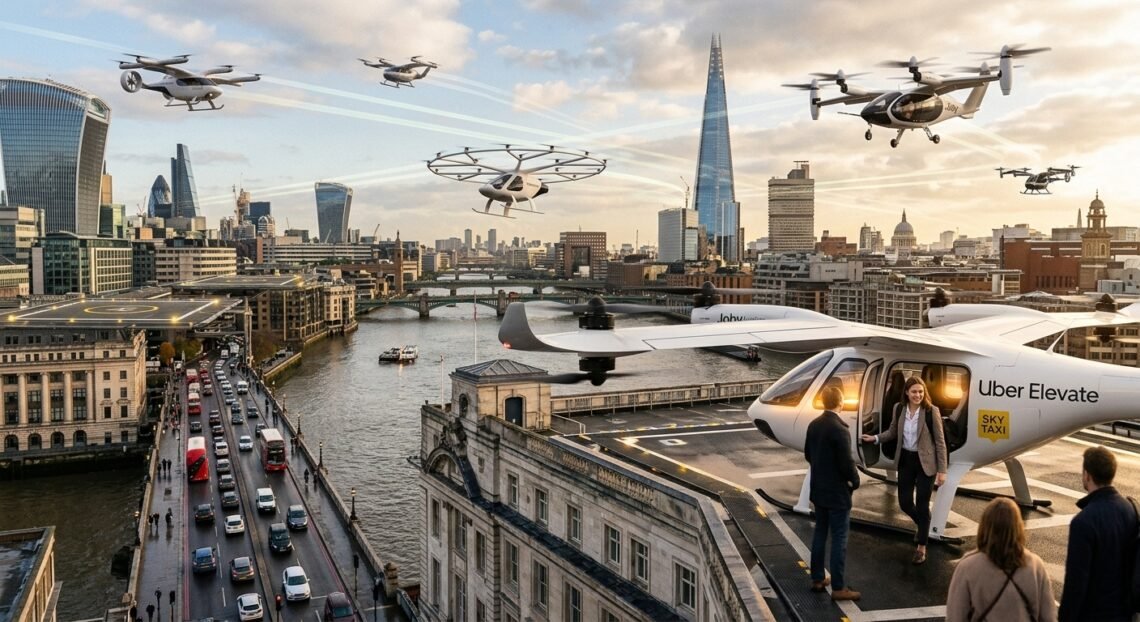
However, over the last few years, the entire conversation shifted. We didn’t get winged sedans stuck in highway traffic; instead, we got electric Vertical Takeoff and Landing (eVTOL) aircraft. Operated autonomously or by remote pilot networks, these modern air taxis are moving out of experimental flight test areas and directly into urban skies.
What Actually Is an Air Taxi?
If you step up to an air taxi today, you won’t see a retrofitted Ford or a stretched helicopter. Modern air taxis are ground-up reconsiderations of flight.
Most designs use distributed electric propulsion—meaning multiple smaller rotors spread across a fixed wing or frame rather than one massive overhead blade. This approach yields three crucial advantages:
- Drastic Noise Reduction: Traditional helicopters generate deafening blade-slap noise. Distributed electric rotors spin at lower tip speeds, producing a quiet hum that blends easily into ambient city sounds.
- Safety Through Redundancy: If a helicopter loses its main rotor, it drops. If an eVTOL loses one or two electric motors, the remaining units adjust instantly to keep the vehicle stable.
- Zero Direct Emissions: Powered by lithium-ion battery banks or hydrogen fuel cells, they emit no direct exhaust during flight.
These aircraft don’t require runways. They lift off vertically like a drone, transition their rotors forward to fly efficiently like an airplane, and land on specialized urban pads called vertiports.
The Shift to Full Autonomy
While early commercial routes are launching with trained pilots on board to build public trust and meet regulatory standards, the endgame for developers like Wisk Aero, EHang, and Joby Aviation is full autonomy.
Why push for pilotless flights? It comes down to basic economics and spatial geometry.
Adding a human pilot takes up a seat that could otherwise hold a paying passenger or cargo. A four-seat air taxi operating without a pilot increases its revenue capacity per trip by 25%. Furthermore, scaling an urban flight network across major metropolitan hubs requires thousands of active flights daily. The global commercial aviation industry already faces a pilot shortage; relying entirely on human operators would cap the growth of air taxis before they ever hit scale.
┌─────────────────────────────────────────────────────────┐
│              Autonomous Flight Sensors                  │
├──────────────────┬──────────────────┬───────────────────┤
│  Optical Cameras │   LiDAR Arrays   │ Radar Systems     │
│  Identifies visual│  3D spatial      │ Detects weather & │
│  landmarks       │  mapping         │ distant traffic   │
└─────────┬────────┴────────┬─────────┴─────────┬─────────┘
          │                 │                   │
          └─────────────────┼───────────────────┘
                            ▼
              Central Processing Core
     Processes sensor fusion & flight telemetry
                            │
                            ▼
           Triple-Redundant Flight Actuators
Autonomous flight software doesn’t blink, doesn’t get distracted, and reacts in milliseconds. Using continuous sensor fusion, onboard computers process radar data, optical camera feeds, and real-time flight path adjustments faster than any human pilot could react.
What’s Holding Us Back?
If the technology works, why isn’t everyone commuting over gridlocked traffic right now? The remaining hurdles aren’t about getting off the ground; they’re about managing what happens once thousands of aircraft share the same low-altitude airspace.
Air Traffic Management at Scale
Traditional air traffic control relies on human controllers speaking to pilots over radio frequencies. That system breaks down when you add hundreds of autonomous air taxis flying low-altitude routes between downtown vertiports and suburban hubs. Regulators like the FAA and EASA are working with tech firms to build automated, digital air traffic networks capable of routing unmanned traffic in real time.
Grid Infrastructure and Battery Density
Lifting a multi-thousand-pound aircraft vertically takes immense energy. Vertiports require high-capacity megawatt charging stations capable of topping off an air taxi’s batteries in the 10-15 minutes it takes passengers to deplane and board. Municipal power grids in major cities must adapt to support these dense power draws.
Public Acceptance and Cost
Will everyday commuters feel comfortable boarding an aircraft with no steering wheel and no pilot sitting up front? Overcoming the psychological hurdle requires flawless safety records and transparent operations. Early flights will inevitably cater to premium business travelers and airport transfers, but costs must fall toward ride-share rates for the service to achieve long-term viability.
The Road Ahead
We are witnessing the early stages of a fundamental shift in transportation. As regulatory frameworks finalize and vertiport infrastructure expands, urban point-to-point travel will move into three dimensions. The flying car didn’t arrive as a personal toy for your driveway—it arrived as an autonomous, electric transit network designed to give hours back to people trapped in city traffic below.